Independent Indesit cooking-appliance repair support in Tunbridge Wells, covering suitable electrical faults on freestanding cookers, built-in ovens and ceramic/induction hobs. We focus on suitable electrical cooking faults. Gas leaks, gas-supply faults, gas burner faults and gas ignition repairs are outside this service.
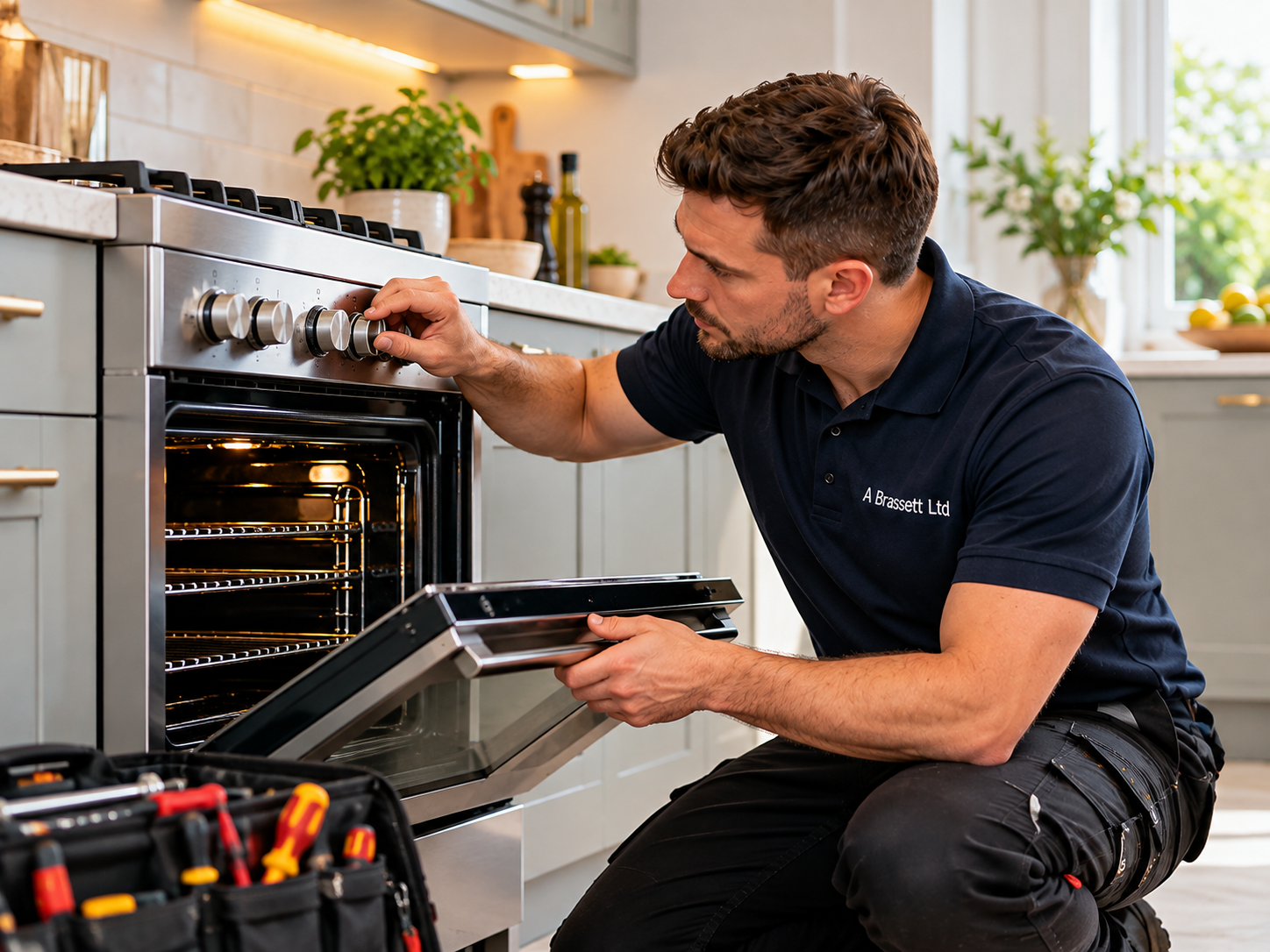
Current Indesit UK cooking products include freestanding electric cookers, built-in single and double ovens, ceramic hobs and induction hobs. Exact model and rating-plate details matter because electronics and parts vary.
These are associated brands within the current Beko Europe portfolio. Brand association does not mean parts, fault codes or electronics are interchangeable. Exact model identification remains essential.
Possible diagnostic areas and safe first checks — not a remote confirmation of a failed part.
Possible fault areas: Heating element, selector, thermostat/sensor, relay/control or wiring.
Safe first checks: Record which cavity and function are affected.
Possible fault areas: Fan element, wiring, relay/control or temperature sensing.
Safe first checks: Check whether conventional or grill functions still heat.
Possible fault areas: Fan motor, blade obstruction, wiring or control.
Safe first checks: Stop if scraping, burning or severe noise occurs.
Possible fault areas: Fan motor bearing, blade contact, loose fixing or debris.
Safe first checks: Stop if there is heavy scraping or vibration.
Possible fault areas: Grill element, selector, thermal cut-out, control or wiring.
Safe first checks: Note whether one or both grill sections work.
Possible fault areas: Element, selector, thermostat/sensor, control or wiring.
Safe first checks: Record the exact function that fails.
Possible fault areas: Element, fan system, thermostat/sensor, selector or control.
Safe first checks: Check whether display/timer settings are normal.
Possible fault areas: Temperature sensor/thermostat, relay/control or airflow issue.
Safe first checks: Stop if temperatures are clearly excessive.
Possible fault areas: Fan performance, element, sensor/thermostat, airflow or loading.
Safe first checks: Compare results on more than one shelf position.
Possible fault areas: Heating element earth leakage, wiring, fan motor, terminal block or control.
Safe first checks: Stop using and do not repeatedly reset the supply.
Possible fault areas: Wiring, terminal block, element, motor or control overheating.
Safe first checks: Stop using immediately and isolate safely.
Possible fault areas: Supply, terminal block, clock/timer, control or internal wiring.
Safe first checks: Check the normal isolator/consumer-unit supply only.
Possible fault areas: Clock/timer, user interface, supply, control or wiring.
Safe first checks: Check whether any heating function still operates.
Possible fault areas: Clock/timer module, buttons, user setting or control.
Safe first checks: Follow the normal clock-setting procedure first.
Possible fault areas: Power interruption, timer setting or control issue.
Safe first checks: Reset the clock according to the model instructions.
Possible fault areas: Worn selector contacts, damaged switch, connection or control.
Safe first checks: Do not force a stiff or arcing control.
Possible fault areas: Sensor/thermostat, calibration, control or airflow.
Safe first checks: Note whether the oven is consistently too hot or too cool.
Possible fault areas: Temperature sensing, relay/control, ventilation or cooling-fan fault.
Safe first checks: Allow normal cool-down time; persistent running needs diagnosis.
Possible fault areas: Cooling-fan motor, bearing, loose fixing or obstruction.
Safe first checks: Stop if severe scraping or burning occurs.
Possible fault areas: Hinge, receiver, seal, alignment or obstruction.
Safe first checks: Do not force the door.
Possible fault areas: Hinge, hinge receiver, door structure or fixing.
Safe first checks: Avoid loading weight onto the open door.
Possible fault areas: Worn, split, detached or heat-damaged gasket.
Safe first checks: Check the correct seal for the exact model.
Possible fault areas: Glass panel, trim, fixing or door-frame fault.
Safe first checks: Stop using if glass is cracked or loose.
Possible fault areas: Lamp, holder, switch/control or wiring.
Safe first checks: Use only the correct heat-rated lamp if user-replaceable.
Possible fault areas: Heating element, regulator, connection or control.
Safe first checks: Stop if the glass is cracked.
Possible fault areas: Cookware detection, induction module, sensor, coil or control.
Safe first checks: Try known induction-compatible cookware.
Possible fault areas: Cookware type/size, pan sensor, coil or power module.
Safe first checks: Test with known compatible cookware.
Possible fault areas: Control lock, moisture, user interface or control module.
Safe first checks: Clean/dry the panel and check lock settings.
Possible fault areas: Element, power module, wiring, terminal block or moisture ingress.
Safe first checks: Stop using and do not repeatedly reset the circuit.
Possible fault areas: Cavity-specific element, selector, thermostat/sensor or wiring.
Safe first checks: Record exactly which cavity or function fails.
Possible fault areas: One cavity, ceramic hob section, timer, fan or control circuit may be isolated.
Safe first checks: List every function that still works.
Possible fault areas: Oven element, selector, thermostat/sensor, timer/control or wiring.
Safe first checks: Record whether grill/top oven functions work.
Possible fault areas: Filters, fan motor, controls, ducting or airflow.
Safe first checks: Clean user-accessible filters and note fan-speed behaviour.
Possible fault areas: Lamp/LED module, driver, switch, control or wiring.
Safe first checks: Check whether all hood lights fail or only one.
Possible fault areas: Element, sensor, relay, selector, wiring or overheating protection.
Safe first checks: Record when the heat drops out.
Possible fault areas: Model-specific sensor, control, power or communication issue.
Safe first checks: Photograph the exact code and model/rating plate.
Possible fault areas: Knob, shaft, selector, thermostat spindle or control fitting.
Safe first checks: Do not force a damaged spindle.
Possible fault areas: Loose/burnt connection, supply cable or terminal damage.
Safe first checks: Stop using immediately and arrange electrical diagnosis.
Possible fault areas: Overheating protection, sensor, fan, control or supply issue.
Safe first checks: Record run time before cut-out and whether it restarts after cooling.
Possible fault areas: Fan blade, loose panel, component fixing or vibration.
Safe first checks: Stop if the noise becomes severe or metallic.
Select an area to focus the map. Final attendance depends on the full postcode, appliance, fault and current engineer route.
Map: Tunbridge Wells, UK
Every Indesit area link below points to a file included in this upload batch. Supporting site links use established A Brassett pages.
Yes, suitable oven, grill, ceramic-hob, fan, timer, control, element and electrical faults can be assessed.
Yes, suitable single and double built-in oven faults can be assessed, subject to model and parts availability.
Suitable induction power, control, sensor, cooling and pan-detection faults can be assessed.
Yes. Indesit, Hotpoint and Whirlpool are currently among the brands listed within the Beko Europe portfolio. Parts are still model-specific.
Coverage is route-planned Monday to Thursday and confirmed from the full postcode when booking.
No. Gas leaks, gas-supply faults, burners and gas ignition systems are outside this repair service.
Engineer visits are scheduled Monday to Thursday. Concentrating our field routes into four organised service days helps us plan travel efficiently and offer clear appointment windows, while maintaining the dependable service expected from a family business established in 1984.
Visit windows: Morning 8:00–10:30 · Extended Morning 8:00–13:30 · Afternoon 12:00–16:00 · All Day 8:00–16:00. Subject to route and booking availability.