
Do you repair integrated Rangemaster dishwashers?
Suitable integrated dishwasher faults can be assessed, subject to the exact model, access, fault and parts availability.
Independent Rangemaster dishwasher repair support in Eastbourne for integrated and freestanding machines. Search 36 fault routes, check the local map, use AI or SI for guided help, and book online when you are ready.
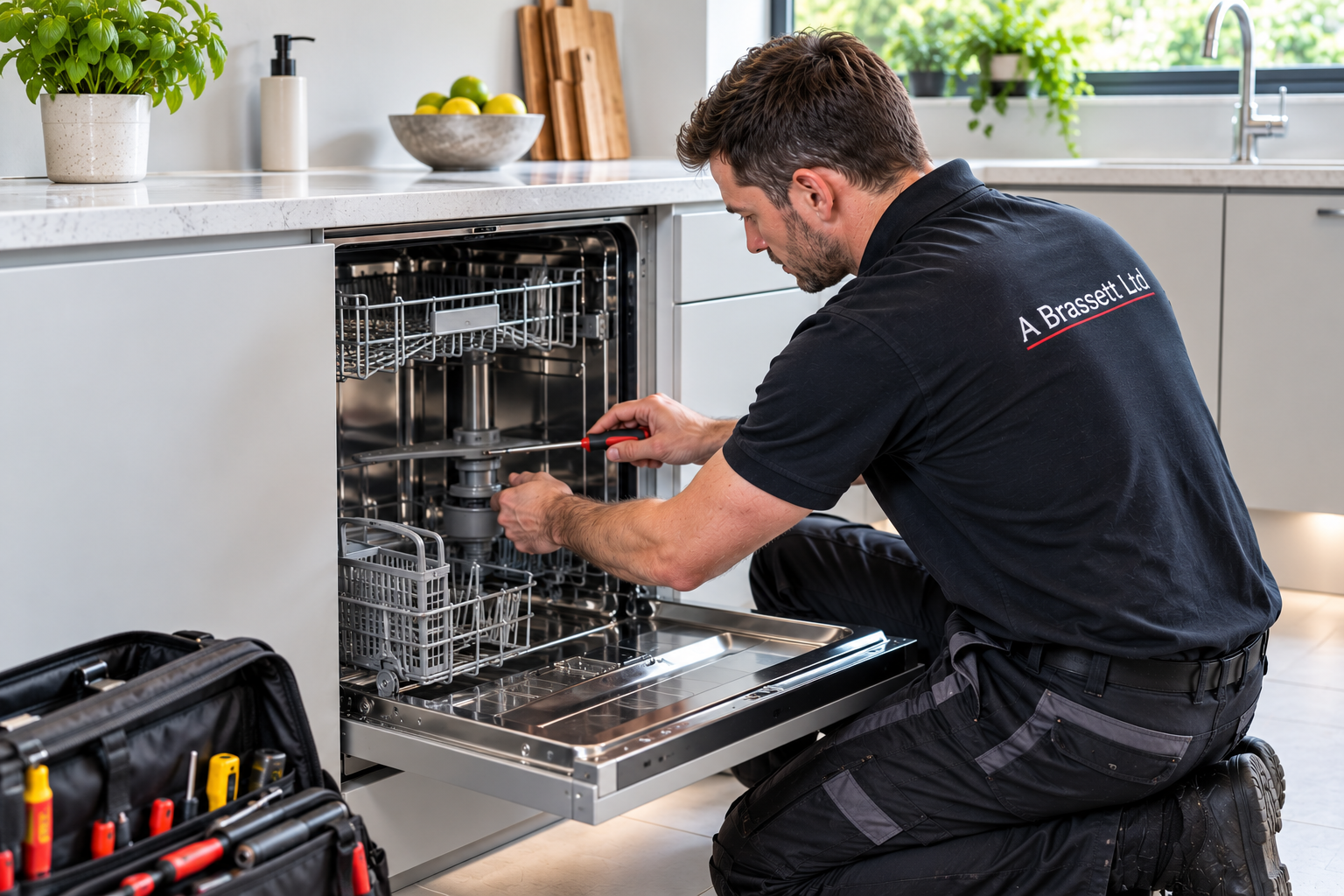
The uploaded pages were built around both freestanding and built-in Rangemaster dishwashers. This rebuild keeps that repair focus, removes outdated sales and 48-hour promises, and adds clearer symptom-led fault guidance.
Select a nearby area to focus the map. Final attendance depends on the full postcode, appliance details, fault and current engineer route.
Eastbourne, Willingdon, Polegate, Pevensey, Hailsham, Seaford, Lewes, Bexhill
Map: Eastbourne, UK
Search by symptom. These are possible diagnostic areas and safe first checks, not a remote confirmation of the failed component.
Possible fault areas: Mains supply, door interlock, wiring, user interface or main control electronics.
Safe first checks: Check the socket safely and confirm the door closes normally. Do not remove electrical covers.
Possible fault areas: Door latch/interlock, control lock, programme selection, user interface or control.
Safe first checks: Check the door, selected programme and any control-lock setting.
Possible fault areas: Water supply, inlet hose/filter, inlet valve, anti-flood system or control.
Safe first checks: Confirm the supply is on and the visible inlet hose is not kinked.
Possible fault areas: Restricted supply, inlet filter, hose restriction or inlet valve.
Safe first checks: Check the tap is fully open and the hose is not crushed.
Possible fault areas: Circulation pump, wash motor, blocked hydraulic path, wiring or control.
Safe first checks: Note whether you can hear circulation after filling.
Possible fault areas: Loading, spray arms, filters, circulation, detergent, heating or water-temperature issue.
Safe first checks: Clean user-accessible filters and spray arms and check loading.
Possible fault areas: Upper spray arm, feed tube, loading obstruction, circulation pressure or blockage.
Safe first checks: Check the upper spray arm can rotate freely.
Possible fault areas: Lower spray arm, circulation pressure, blockage, loading or pump performance.
Safe first checks: Check the lower spray arm can rotate freely.
Possible fault areas: Blockage, circulation pressure, pump, loading obstruction or damaged spray arm.
Safe first checks: Remove visible debris from user-accessible spray-arm holes if appropriate.
Possible fault areas: Filter/sump blockage, drain pump, impeller obstruction, drain hose or control.
Safe first checks: Clean the user-accessible filter and check the visible drain hose for kinks.
Possible fault areas: Drain restriction, pump, anti-flood condition, leak or level sensing.
Safe first checks: Stop if there is visible leakage and note whether the pump keeps running.
Possible fault areas: Anti-flood condition, water in base, pressure/level sensing or control.
Safe first checks: Stop if leakage is suspected; do not tip or dismantle the appliance.
Possible fault areas: Leak into base, float switch, inlet safety system, hose or internal water path.
Safe first checks: Stop using if leakage is suspected and arrange inspection.
Possible fault areas: Door seal, lower seal, spray pattern, loading, overfill or alignment.
Safe first checks: Inspect the visible seal and make sure nothing prevents the door closing.
Possible fault areas: Pump/sump assembly, internal hose, inlet system, seal or base tray.
Safe first checks: Stop if water is near electrics and note where the leak first appears.
Possible fault areas: Heater earth leakage, pump/motor, wiring, moisture ingress or another electrical fault.
Safe first checks: Stop using and do not repeatedly reset the electrical supply.
Possible fault areas: Wiring, pump/motor, heater, control or another component overheating.
Safe first checks: Stop using immediately and isolate the appliance safely.
Possible fault areas: Heater, temperature sensor, pressure/flow sensing, relay/control or wiring.
Safe first checks: Note whether the cycle completes and whether dishes remain cold.
Possible fault areas: Heating, airflow, rinse aid, programme, sensor or control.
Safe first checks: Check rinse aid and programme selection and note whether the appliance heats.
Possible fault areas: Dispenser, spray pattern, water temperature, loading, circulation or programme issue.
Safe first checks: Check tall items are not blocking the dispenser or spray arms.
Possible fault areas: Dispenser mechanism, obstruction, wiring or control.
Safe first checks: Check crockery is not physically blocking the dispenser lid.
Possible fault areas: Rinse-aid level/sensor, cap, dosing system or control/display issue.
Safe first checks: Refill as instructed and check the cap is seated correctly.
Possible fault areas: Salt level/sensor, cap, regeneration setting or control/display issue.
Safe first checks: Check dishwasher salt and water-hardness setting.
Possible fault areas: Salt/rinse-aid dosing, water hardness, detergent or softener setting.
Safe first checks: Check salt cap, rinse-aid dose and local water-hardness setting.
Possible fault areas: Water hardness, detergent/rinse-aid balance, temperature or glass corrosion.
Safe first checks: Review detergent/rinse-aid settings and use a glass-suitable programme.
Possible fault areas: Filter residue, standing water, drain restriction, seals or low-temperature use.
Safe first checks: Clean user-accessible filters and use the manufacturer cleaning programme if advised.
Possible fault areas: Foreign object, pump, circulation motor, spray-arm contact, bearings or loading.
Safe first checks: Check spray arms are not striking dishes and stop for severe grinding.
Possible fault areas: Pump/circulation motor, debris, spray-arm contact or another rotating component.
Safe first checks: Stop if the noise is severe or metallic.
Possible fault areas: Model-specific warning, door, water supply, drain, heating, sensor or control issue.
Safe first checks: Record the beep pattern and any display message.
Possible fault areas: Model-specific sensor, pump, heater, valve, anti-flood, door or control fault.
Safe first checks: Photograph the exact code and rating plate; code meanings can vary by model.
Possible fault areas: Fill, heating, drainage, circulation, door sensing, power or control issue.
Safe first checks: Record the exact stage and any code or lights.
Possible fault areas: Heating, fill/drain restriction, sensor, water temperature or programme logic.
Safe first checks: Note whether it pauses at the same stage every time.
Possible fault areas: Control lock, user interface, power issue, wiring or main control.
Safe first checks: Check the control lock and normal reset procedure in the manual.
Possible fault areas: User interface, moisture, connection or control electronics.
Safe first checks: Record which controls fail and whether the fault changes after drying/cooling.
Possible fault areas: Furniture door adjustment, hinges, latch alignment or installation.
Safe first checks: Do not force the door; note whether the cabinet front is rubbing or dropping.
Possible fault areas: Door catch, hinges, alignment, interlock or integrated furniture-door adjustment.
Safe first checks: Check for obstructions around the door and do not force the latch.
These links were selected from Rangemaster pages already created and checked as live/available during this rebuild. Unverified Rangemaster area URLs have not been added, so the page does not knowingly introduce new 404 links.
Search the current A Brassett London and South East white-goods coverage set and select a town to focus the map.
Suitable integrated dishwasher faults can be assessed, subject to the exact model, access, fault and parts availability.
Common diagnostic areas include filters, the sump, drain pump, outlet hose and control. Start only with user-accessible filters and visible hose checks.
Possible areas include the heater, temperature sensing, flow/pressure sensing, relay/control and wiring.
Stop using it and do not repeatedly reset the supply. Heater leakage, pumps, wiring or moisture ingress can require proper electrical diagnosis.
Engineer visits are scheduled Monday to Thursday, subject to route and booking availability.
Yes. Use the Book Online button on this page to submit a service request securely.
Engineer visits are scheduled Monday to Thursday. Concentrating our field routes into four organised service days helps us plan travel efficiently and offer clear appointment windows, while maintaining the dependable service expected from a family business established in 1984.
Visit windows: Morning 8:00–10:30 · Extended Morning 8:00–13:30 · Afternoon 12:00–16:00 · All Day 8:00–16:00. Subject to route and booking availability.