Independent Haier repair enquiries across A Brassett’s established London and South East service routes. Check appliance types, common symptoms, associated-brand context, all areas and secure booking.
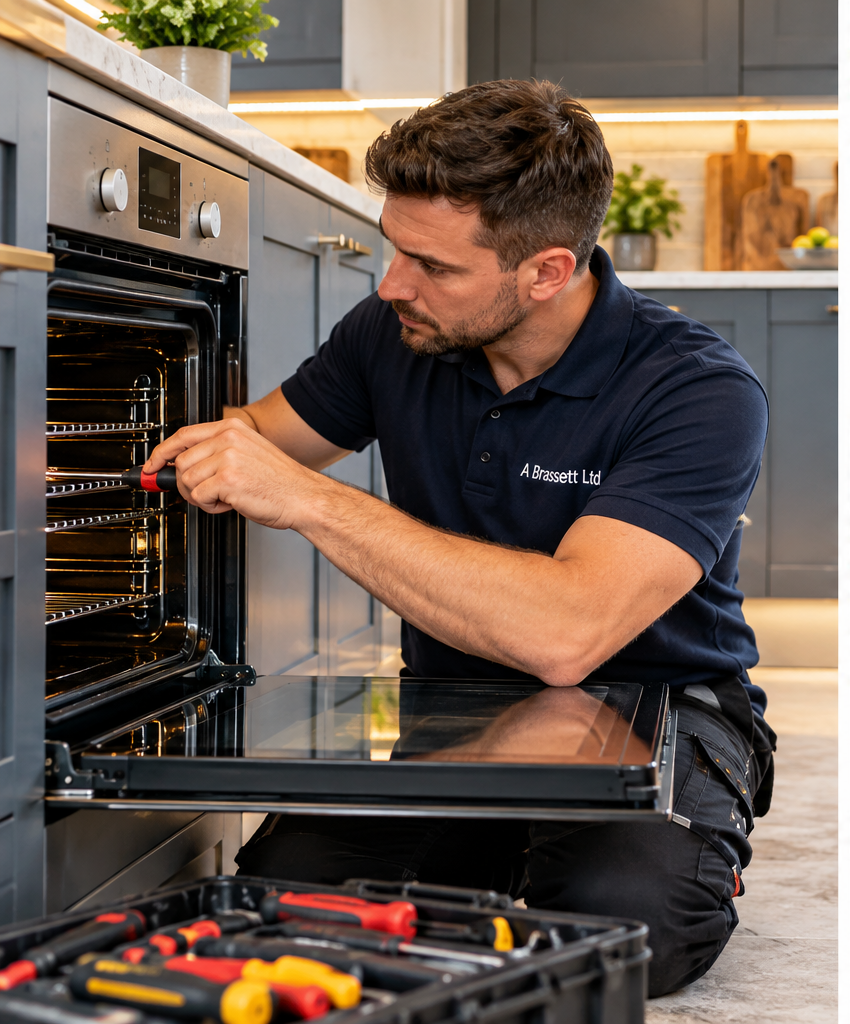
Repair suitability depends on the exact model, age, fault type, installation/access and parts availability. A Brassett Ltd is independent and does not imply manufacturer authorisation.
Search common symptoms across kitchen and laundry appliances. These are possible diagnostic areas and safe checks, not a remote confirmation of a failed component.
Possible diagnostic areas: Power supply, door/lid interlock, user controls, wiring or main control electronics.
Safe first checks: Check the socket, door/lid closure and normal control-lock setting.
Possible diagnostic areas: Heating component, motor/pump, wiring, moisture ingress or another electrical component.
Safe first checks: Stop using and do not repeatedly reset the supply.
Possible diagnostic areas: Model-specific sensor, motor, heater, pump, fan, control or communication issue.
Safe first checks: Photograph the exact code and rating plate; meanings vary by model.
Possible diagnostic areas: Control lock, user interface, connection, supply or main control.
Safe first checks: Check the normal reset/control-lock procedure in the manual.
Possible diagnostic areas: Seal, hose, pump/sump, inlet path, door seal or internal connection depending on appliance.
Safe first checks: Stop if water is near electrical parts and note where it first appears.
Possible diagnostic areas: Filter, pump, hose, blockage, pressure sensing or control depending on appliance.
Safe first checks: Clean only user-accessible filters and check visible hoses for kinks.
Possible diagnostic areas: Heating element/system, temperature sensor, relay/control, airflow or wiring.
Safe first checks: Record whether the programme completes and whether an error code appears.
Possible diagnostic areas: Loading/use, filters, airflow/waterflow, sensor, heating or control issue.
Safe first checks: Check user-accessible filters, settings and appliance loading.
Possible diagnostic areas: Motor, pump, fan, bearing/support, foreign object or mechanical contact.
Safe first checks: Stop for severe grinding, scraping, smoke or burning smells.
Possible diagnostic areas: Hinge, catch, seal, alignment, furniture-door fitting or obstruction.
Safe first checks: Do not force the door; check for trapped items or visible misalignment.
Possible diagnostic areas: Connection, sensor, control, overheating protection or component beginning to fail.
Safe first checks: Record exactly when the fault appears and whether cooling/resting changes it.
Possible diagnostic areas: Electrical overheating, motor, wiring, heater or another component.
Safe first checks: Stop using immediately and isolate the appliance safely.
Possible diagnostic areas: Drainage, motor, belt/drive, speed sensing, imbalance or control.
Safe first checks: Check whether water has drained and whether the load is badly unbalanced.
Possible diagnostic areas: Filters, spray arms, circulation, heating, loading or detergent path.
Safe first checks: Clean user-accessible filters/spray arms and check loading.
Possible diagnostic areas: Water supply, inlet hose/filter, inlet valve, anti-flood system or control.
Safe first checks: Confirm the supply is on and the visible inlet hose is not kinked.
Possible diagnostic areas: Filters, airflow, heat exchanger, moisture sensing, heating/heat-pump system or load.
Safe first checks: Clean all user-accessible filters and use the recommended load.
Possible diagnostic areas: Drive belt, motor, drum support, capacitor where fitted or control.
Safe first checks: Stop if there is a burning smell and note whether the motor can be heard.
Possible diagnostic areas: Door seal, fan/airflow, sensor, defrost, control or sealed-system performance.
Safe first checks: Check temperature settings, door closure and internal vents.
Possible diagnostic areas: Door seal, door left ajar, defrost heater/sensor, fan or defrost control.
Safe first checks: Check the gasket and do not chip ice with sharp tools.
Possible diagnostic areas: Element, temperature sensor/thermostat, selector, relay/control or wiring.
Safe first checks: Record which oven function fails and whether the fan operates.
Possible diagnostic areas: Fan motor, blade contact, bearing, loose fixing or obstruction.
Safe first checks: Stop if scraping is severe or accompanied by burning.
Possible diagnostic areas: Element/induction module, pan detection, sensor, control or wiring depending on hob type.
Safe first checks: Check compatible cookware and normal control-lock settings.
Possible diagnostic areas: Sensor/thermostat, element cycling, fan/airflow or electronic control.
Safe first checks: Compare different functions and record whether the fault is cavity-specific.
Map: Bromley, UK
Related services are kept clear without mixing in the old plumbing, boiler or drainage material.
Engineer visits are scheduled Monday to Thursday. Concentrating our field routes into four organised service days helps us plan travel efficiently and offer clear appointment windows, while maintaining the dependable service expected from a family business established in 1984.
Visit windows: Morning 8:00–10:30 · Extended Morning 8:00–13:30 · Afternoon 12:00–16:00 · All Day 8:00–16:00. Subject to route and booking availability.